- Courting Context
- Posts
- Tetrads For Our Times
Tetrads For Our Times
Feeling stuck? Change the channel. Two tetrads can show you how.
Grief demands witness. Procrastinating the process of grief only ricochets within the nervous system, across interpersonal relationships, or just generally builds a pressure that is more likely to cause unexpected damage versus the guarantee of hurt and humiliation in turning towards the pain, accepting it completely, allowing it to reshape one’s interior terrain, like a historic landslide of the soul.
Humans famously avoid pain for the pursuit of pleasure, but change is the only constant on this mortal coil. When pleasure-seeking becomes chronic, with unequal periods of pain to punctuate the monotony, necessarily delivers diminishing results, it can start to look a lot more like something else: addiction.
We’re told to not look away from daily horrors. That we must remain informed for our own safety, sanity, protection, and progress. Don’t put your head in the sand, however tempting. Silence is complicit. This galvanized most of my social media presence during my heavy usage years: it felt like my duty as a citizen and human to not only remain aware, but deeply engaged with the conversations, the discourse, the responses.
But there’s another thought-terminating cliche most of us have heard growing up, too: Silence is golden. This one’s been bandied about usually as a control mechanism, aimed at the garrulous, noisy, and otherwise vocally disruptive. A hush, a censor. So it’s no wonder that Americans, steeped in a legacy of dubious exceptionalism, trained for decades by social media prompts to share What’s on your mind? might agree with silence being more complicit than golden.
Of course, both are true. It depends on the context.
But when the context is unrecognizable, unfamiliar, or fracturing faster than we can fully comprehend, we face far more variables than we’re used to factoring into our mental calculations. Increased complexity and uncertainty can make simple binary frameworks feel soothing: familiar and comfortable, we’re encouraged to surrender to Good vs Bad, Pain vs Pleasure, Complicit vs Golden just to feel like we can make some choice, any choice. But what is the nature, the quality, of that kind of choice?
Is a choice between Heinz and Hunts ketchup really even a choice at all?

What is lost in this incessant imperative to choose, in this reductionistic notion of choice, is that choice is not free, not untethered. Choice is secreted by larger territorial flows, desires as a terraforming project. The very act of choosing is the creation of both the options and the chooser.
They both arise simultaneously, together. Instead of being something that springs from the stable self, it is the rushing volatility of desire that enacts both the options and the subject that chooses. Options do not predate the act of choice, and the chooser does not predate the choice.
This is why I say that both choice and the organism are created by the environment. ‘We’ do not ‘have’ free will; we are indebted to every encounter, enlisted in every meeting, modified in every moment. The raw resources deployed to produce the modern fetish of choices are excavated from strange places, torn from the skin of errand winds, living stranger lives than their stated purpose.
Yes, choice can thrive well in fascism — because choice and control are not antithetical. Perhaps the most resilient forms of fascism are those ones that offer voting cards to their citizens.
Bayo goes on to suggest that the “third act of desire… is the emergence of a monster - a ‘demonstration’, a meeting of the strangeness of self, a breaking off from the trance of continuity. The monster lives at the edges of choice-control. The monster is that moment when the awkwardness of choosing gains its own subjectivity, chastising the fixity of the chooser…. The monster is when wounds open in the body of the known, when new worlds hiss in new anticipation.”
Maybe you’ve been feeling these wounds for awhile. Maybe hearing the hiss is new.
Maybe you broke off from the trance of continuity years ago.
Maybe, like me, the pressure of the pandemic broke the trance for you.
But many, if not most, are still under the trance of continuity. It’s a powerful spell that claims even those who manage to achieve escape velocity, sometimes several times within a lifetime. Joanna Macy calls this trance the Narrative of “Business As Usual.”
You know this story — you may even use this phrase in your every day communication, as was the case at several prior employers. BAU, handily abbreviated, as a legitimate scope and track of project work: a formal road map for “same as it ever was,” maybe with higher projected estimates thanks to advances in technology promoting increasing levels of scale and speed. But always in pursuit of growth above all. No matter the cost.
There is a second narrative for Macy, which is the Narrative of “The Great Unraveling,” also known as Collapsology has emerged not (only) as doomscroll fodder, but a serious discipline wondering how best to turn our attention and resources away from preventing a collapse (which collapsologists say is already here, and has been for some time, meaning we are well past prevention) and towards, instead, making the collapse we’re in as gentle and kind to all life as is possible.
The Great Unraveling is how we’re accounting for the escalating costs of BAU.

The Unraveling Narrative is profoundly uneasy to work within because of all the grief involved. To see and understand collapse is to mourn endlessly fractal reminders of “the way things were.” And as we’re seeing, this can be so painful that many will turn to any manner of distraction, illusion, even the most paternalistic performances reassuring our lizard brains to postpone, delay, deny, ignore, and reframe all evidence of collapse to prop up the BAU Narrative, all for the sake of comfort, convenience, the never-ending pursuit of pleasure, the never-ending temptation of profit growth.
BAU is no longer sustainable; the ROI will continue to erode in freakish asymmetries until enough of us have the good sense to agree BAU as we knew it is DOA.
Nor can we wallow within The Great Unraveling for long. Grief needs a witness because we are meant to inherit wisdom from those moments. When we fail to grasp the wisdom, grief can turn into incapacitating despair. We can’t think or act or even function well in states of chronic despair — and to violent dominators, this is a feature to exploit, not a bug to fix. It becomes an information warfare tactic to distract and diffuse the energy of your opponent so they are less able to mount a defense. It’s a well-known abuse tactic found in the worst cults, POW camps, and households, families, and intimate partners trapped in prisons of coercive control.
But somewhere between BAU and Collapse, there is a Third Narrative. Another way out.
Deep Adaptation Tetrad: The Four Rs
Thus we get to Macy’s Third Narrative: “The Great Turning.” Bendell calls it Breaking Together. Bayo Akomolafe urges us towards Making Sanctuary. Even Douglas Rushkoff finds himself “… slowly changing from an agent of change to an agent of care.”
Spend a moment with that language: Turning, Together, Sanctuary, Care.
This language matters because these words are not the hard, sharp, militant words that make up hashtaggable battle cries of street protests engineered with content calendars in mind. These are not the words that correlate with corporeal catastrophes of battles or moments of warfare.
This is not about fighting fire with even more fire.
This is about seeing just how scorched and blistered everything is, then acting to quench the flame, soothe the hurt, and offer healing.
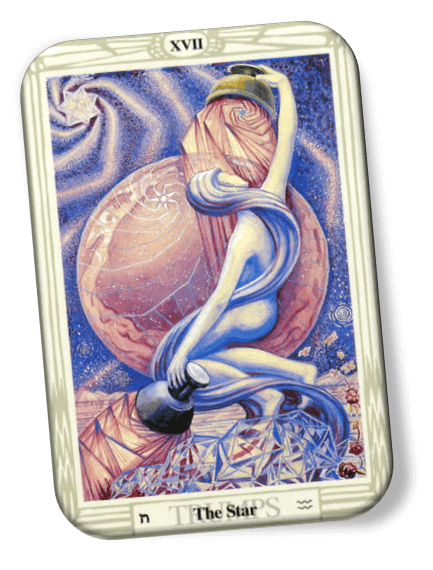
These are soft words that speak more to a reduction in energetic response, like an unclenching of tension. An exit, instead of voice.
Something more like surrender, shaped like compassion, moved by love.
When we can move past the painful abyss of loss, when we let the tears clear the trance from our eyes, when we surrender to witness grief and are rewarded with wisdom, we can begin start to see particles of possibility.
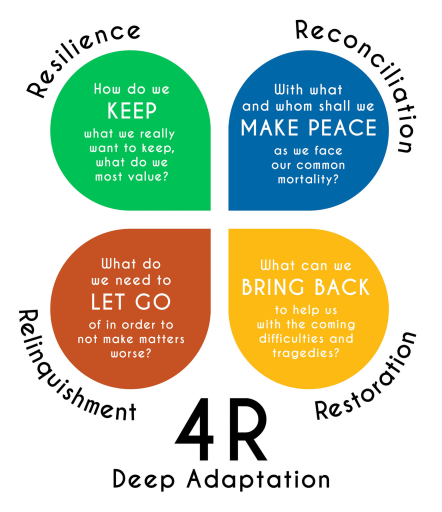
Like the familiar Reduce, Reuse, Recycle refrain, Deep Adaptation’s Four Rs feel all grown up and deeply dimensional, offering a powerful lens to gain some ground when momentum stands still.
What happens when you point these inquiries in your own life? When it comes to your material landscape, what answers come up for you seen through this tetrad?
At home, at work? Within your relationships?
What about your media habits? Mental states?
Which myths and larger stories require revisions?
McLuhan’s Tetrad: Media Effects
Media is more loaded than ever, so it’s critical to get curious about media studies and media codes because the technology to bypass human cognitive bias has exceeded human ability to protect and adapt. That may sound hyperbolic, so take a moment with this Cognitive Bias codex to get a sense of how many mental shortcut-adaptations are getting activated on a regular basis (at home, at work, online?)…

Not sure where to start making changes? Here’s one you can do with the kids: the Figure / Ground phenomenon sorts the things we actively focus on and pay attention to as the figure, and the things we tend to ignore are (part of the back) ground. This knowledge becomes even more critical as media becomes even more focus-grabbing (through hyper-stimulating, attention-competing, gamified, monetized incentives).
You can find all kinds of selective attention test demonstrations online, but here’s the one that truly got me.
These are great to watch on video because you can literally just pause and rewind the exact same video to prove your own easily-misled attention to yourself. (Or, for the overachievers, testing your own powers of attention!) And it’s best to do with your kids to show how easily cognitive bias can affect all ages, all types, all backgrounds. Which means, for most of us, all it takes is a person more powerful than you telling you how to focus your attention and your brain will literally dump data directly from your senses.
Thinking is hard! That’s why we’ve evolved to automate as much of our own human thought processes as possible, for streamlining and efficiency. That was a smart move when calories were harder to come by, but as our caloric context has dramatically shifted, we might need to think about where our automated cognitive habits have crystallized into biases that have come to hurt us more than help us.
This is where McLuhan’s Tetrad of Media Effects becomes an excellent tool to update boundaries blocking out toxic noise and traumatic distractions, and boost filter quality to find and connect to more life-affirming joy as we acclimate to rapid change in an increasingly illusory ecology, now available for even more to actively engineer.

Try it out with your favorite mediums, as McLuhan intended: digital video, newsletters, in-person gatherings. Technology, specific ideologies, even abstract concepts like “speed” and “scale” can yield some interesting results. Try out the tetrads in groups.
Try McLuhan’s Tetrad by plugging in Cognitive Bias inputs from the codex!
What seems obvious?
What might come as a surprise?
What’s true for you specifically?
What’s true at broader levels (friends, family, community, nation)?
Where can you pivot? Immediately, soon, eventually?
What could you release? (Immediately, soon, eventually?)
Where in your life could you cultivate more care, compassion, creativity, curiosity?
Amid the ruins of a fallen Tower, what mosaic works of art might you shape?
p.s. The refresh of financialosophy.com is now live! Let me know what you think (and if I missed any typos I should correct before a more formal launch…)